What Is Specialty Coffee? Specialty Beans, Varieties, and Origins
Specialty Coffee is coffee that scores 80 or higher in a cupping evaluation conducted by a Q-grader. This specialty coffee evaluation is based on its flavor, aroma, body, acidity, and aftertaste. If a coffee performs well in this evaluation, it earns higher scores and is graded as a specialty coffee.
Table of Contents
I decided to shift from commodity coffee to specialty coffee.
But before doing that, I had no idea what the difference was between regular and specialty coffee.
One I drank at in my college cafeteria or at a local coffee cart, and the other was served only by fancy cafes.
What was the difference that made the fancy coffee so expensive?
Was it the taste? Could be because it is… decadent.
Or was it that the coffees were entirely different?
Why are there so many kinds of coffee? What’s the science behind them?
So many questions and I needed answers.
I put on my detective goggles, started researching, and here’s the guide that explains what makes specialty coffee brands special.
What Is Specialty Coffee?
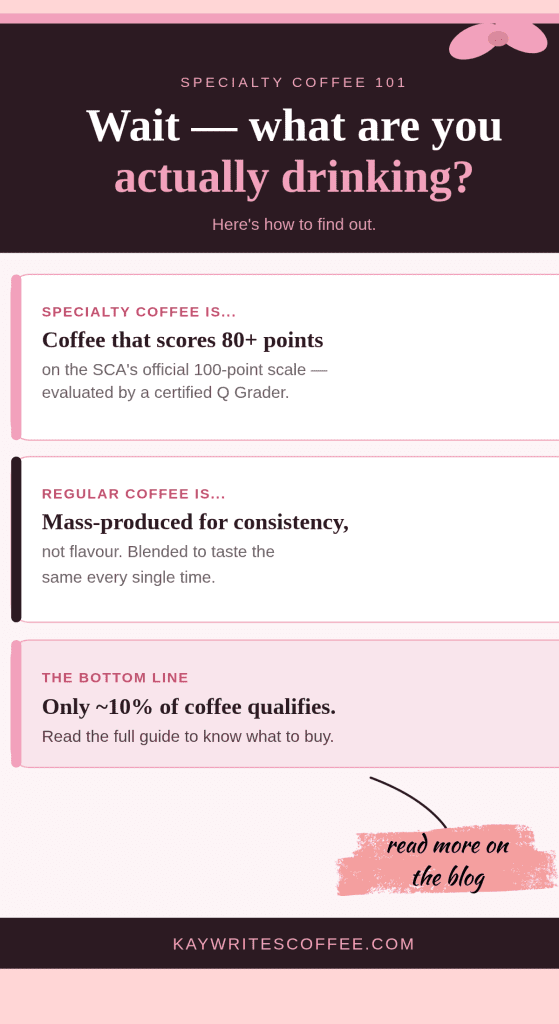
Specialty coffee, according to the Specialty Coffee Association (SCA), is coffee that scores 80 points or higher on a 100-point cupping evaluation conducted by a Q grader.
A Q grader is a coffee taster who holds certification from the Specialty Coffee Association after passing a set of exams.
The scores are given based on fragrance, aroma, taste, aftertaste, body, acidity, uniformity, cleanness, and sweetness.
A coffee cup must perform well on all of these to be graded as a specialty coffee.
A coffee with a score below 80 points is considered a commodity or commercial coffee.
Commercial coffee is what you find at supermarkets for cheap and at fast food carts.
80 points and above is specialty, 85-89 is incredible, and anything above 90 is world-class.
The term “specialty coffee” was coined by Erna Knutsen, a coffee explorer.
She tasted coffees and described their flavor profiles from different microclimates.
The SCA later formalized Erna’s scoring system, and it’s still used today.
The SCA Cupping Score: What Those Numbers Mean
If you see a coffee advertised with a proud cupping score, here’s what the scores indicate:
| Scores | Meaning |
| 90-100 | World-class, exceptional coffee. |
| 85-90 | Excellent, notable specialty coffee. |
| 80-84 | Specialty grade. |
| Below 80 | Commodity or commercial coffee. |
Now we know specialty coffee is the class topper among coffee kinds. But what makes it so special, other than scores?
How is Specialty Coffee Different from Commercial Coffee?
The difference between specialty and commercial coffee starts at the root.
Specialty farmers choose ripe cherries, not underripe or overripe ones.
They process them carefully, avoiding mistakes that could spoil the entire batch.
The specialty roasters roast them without burning the complex flavors.
So yes, the difference starts at the farm.
Farming Stage
Specialty coffee is grown at higher altitudes, approximately between 1000 and 2200 meters above sea level.
At higher altitudes, temperatures are lower, allowing the coffee cherry to grow gradually.
It gives more time for the development of complex sugars and acids inside the bean.
This is why the high altitude is one of the main components of a quality cup.
At specialty farms, farmers handpick only ripe, red cherries rather than strip entire branches.
Even one underripe or overripe cherry can bring the entire batch down to specialty grade.
Processing Stage
At the processing stage, coffee cherries are turned into green beans using methods such as washed, natural, or honey processing.
Specialty producers choose the best method to bring out the specific characteristics of that particular coffee.
Poor processing can downgrade the bean to a lower specialty classification, regardless of how good the coffee cherries were.
These processing mistakes can be fermentation gone wrong, contamination, or uneven drying.
Roasting Stage
Specialty Roasters enhance the bean characteristics by a light roast to preserve its complex flavors.
Because roasting darker can cause a caramelized bitterness that commodity coffee often has.
The verdict of the difference is:
Specialty coffee is built on flavor and transparency, while commercial coffee is built on volume and consistency.
Coffee Varieties Explained
Coffee is a plant, and like any plant, it has varieties or subspecies.
These varieties differ significantly in character, whether in appearance, taste, complexity, antioxidants, or caffeine levels.
Before understanding the coffee plant, let’s dig into two dominant coffee species that rule the coffee world.
1. Coffee Arabica
Arabica coffee accounts for about 60% of the global production.
Arabica grows at high altitude and thrives in temperatures of 15-25 °C.
It is self-pollinating, which enables steady variety development over time.
Arabica coffee contains less caffeine than Robusta at 1.2-1.5% by weight.
It also has a more aromatic profile and a natural acidity that makes it bright.
The majority of specialty coffee is a 100% Arabica beans. You could also call it the backbone of specialty coffee.
2. Coffee Canephora or Robusta
Robusta contains more caffeine than Arabica, at around 2.2-2.7% more, and has a more earthy, bitter profile.
The robusta species is disease-resistant and cheaper to produce.
You will rarely come upon a specialty farm that produces Robusta.
However, some farms are trying to produce specialty-grade Robusta in Uganda and Vietnam.
Robusta is added into espresso blends for its crema quality and caffeine punch.
And in countries like India, where spices are consumed daily, Robusta’s dark flavor suits people’s taste buds.
Read: Arabica Versus Robusta, a full guide.
3. Liberica and Excelsa
These are both rare and regional coffee varieties that are now gaining popularity in the specialty coffee world.
Liberica grows in West Africa and some parts of Southeast Asia.
It has a distinct woody, smoky, and floral character.
Excelsa is scientifically classified as a subspecies of Liberica coffee.
It is known for its tart, fruity profile and complex notes.
It is grown in Southeast Asia, including Vietnam, the Philippines, and Malaysia.
The Most Important Specialty Coffee Varieties
Within Arabica, we see genetic variations that change the entire profile.
The same farm, the same plant, but with changed genetics that matter a lot in a cup.
It’s like Arabica coffee is the parent, and its genetic varieties are children with slight differences.
Those varieties end up in specialty coffee more often than you think because of their unique profiles.
So let’s see what the real difference is really.
Typica
It is the best-known domesticated coffee variety.
Typica also gave rise to sub-varieties such as Blue Mountain (Jamaica), Kona (Hawai’i), and the large-beaned Maragogipe.
It produces a well-balanced, gentle acidity, a clean cup with a smooth body and sweetness.
However, it is susceptible to disease and yields only a small harvest, so it’s quite rare and, as a result, precious.
Bourbon
Bourbon is a mutation of Typica that grew on the island of Réunion.
Its character is sweeter and more complex than its parents.
Bourbon yields a well-rounded, full-bodied cup that carries red fruit, caramel, and brown sugar notes.
It is widely produced in Rwanda, Burundi, and El Salvador.
Gesha (Geisha)
Gesha is one of the most decadent specialty coffees out there.
No discussion of specialty coffee is complete without it.
It was first discovered in the Gesha forest of western Ethiopia.
It gained popularity in 2004 after breaking all records at the Best of Panama competition.
Geisha produces a unique cup with notes of jasmine, bergamot, and tropical fruit.
It has a delicacy that sets it apart from every other coffee variety.
Now, it is grown in Colombia, Ethiopia, Kenya, Costa Rica, and beyond.
It is regularly sold for hundreds, sometimes thousands, of dollars per pound.
F1 Hybrids
F1 Hybrids are the newest development in specialty coffee.
Coffee varieties like Centroamericano and Starmaya were bred by crossing to create disease-resistant Timor hybrids with high-quality Arabica cultivars.
To create varieties resistant to disease and climate change.
Climate change has put traditional varieties under pressure, leading to their large-scale production.
F1 Hybrid creates an impressive cup overall, and it’s been adopted rapidly across Central America.
We have gone over some popular coffee varieties.
Now, it’s time to talk about the origins of coffee.
Specialty Coffee Origins
Coffee origins are not just geography.
It’s geology, climate, rainfall, and framing tradition, all combined into one term, “Terroir.”
The same coffee variety grown in different countries or even farms will taste different.
The specialty coffee is produced in:
- Ethiopia is the oldest coffee-producing country with over 10000 coffee varieties. The coffee-producing regions in Ethiopia include Yirgacheffe, Guji, Sidama, and Harrar.
- Kenya’s coffee is famous for its intensity, and the best Kenyan coffees come from washing stations in Nyeri, Kirinyaga, and Murang’a.
- Colombia produces clean, bright coffee with caramel sweetness and citrus brightness. Production regions include Huila, Nariño, and Cauca.
- Panama is known entirely for its Gesha. Geisha is grown in the Boquete highlands, particularly on farms like Hacienda La Esmeralda.
- Brazil is the world’s biggest coffee producer. The regions in Brazil, including Sul de Minas, Cerrado Mineiro, and Chapada Diamantina, produce the best coffee in the natural process tradition.
- Guatemala’s volcanic highlands have the ideal conditions for complex, full-bodied coffee. Regions like Antigua and Huehuetenango are growing varieties like Bourbon and Catura.
- Indonesian coffee is processed using the unique wet-hulling process called Giling Basah. It produces a blue-green bean and an earthy, low-acid cup with herbal and tobacco notes. The Indonesian varieties are Sumatra, Sulawesi, and Flores.
- Yemen produces a dry-processed coffee with a wild, fermenty, dried-fruit character.
You now know the coffee-producing countries. It’s time to see how the coffee processing methods work.
Coffee Processing Methods
Coffee cherries are picked, dried, and processed.
These methods do a lot to bring out the different flavors or characters to the forefront.
These are washed, natural, honey, and anaerobic fermentation.
1. Washed Processing
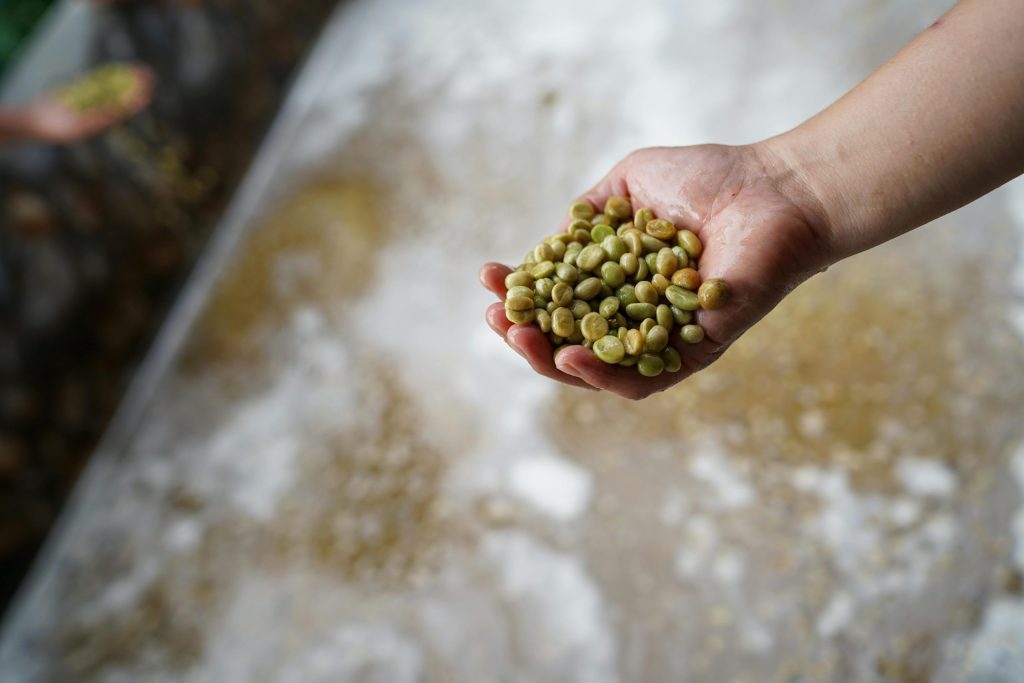
In this method, cherry pulp is removed, and the remaining mucilage is fermented in tanks for about 12 to 72 hours.
After that, the beans are thoroughly washed and then dried.
Washed coffee is clean, bright, and transparent, clearly expressing a variety of characteristics and terroir.
2. Natural Processing
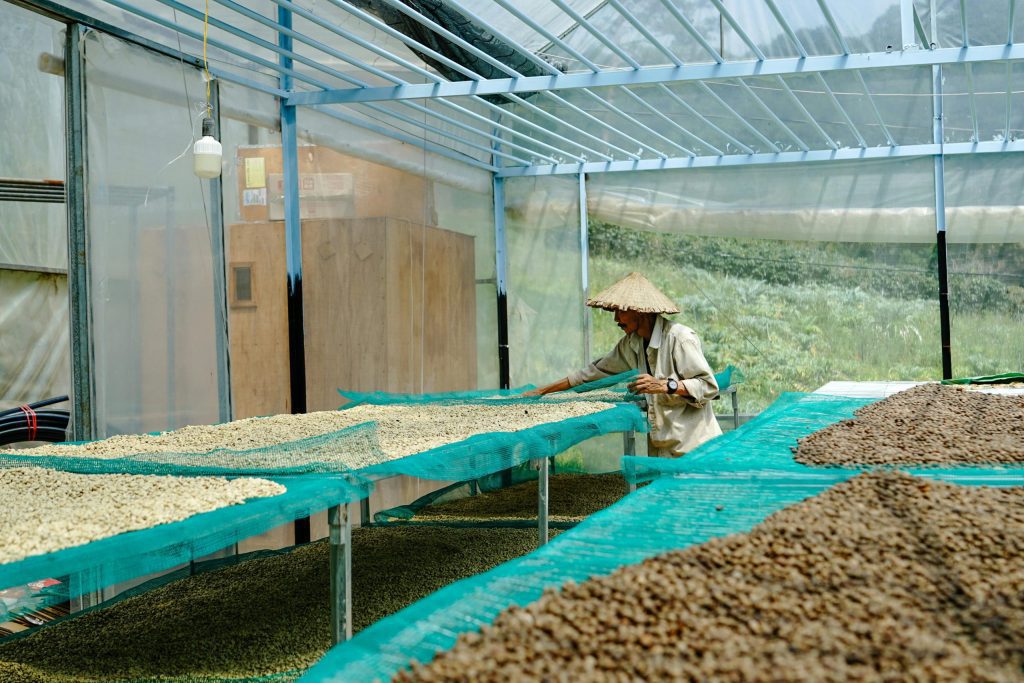
In the process, whole cherries are dried on the patio or in a raised bed for about 3 to 6 weeks.
This results in a complex bean, heavy with a lush body and notes of wine, berry, and tropical fruit.
However, natural processing requires careful management.
If drying is uneven or not done properly, a single fermentation defect can ruin the lot.
3. Honey Processing
In the method, the pulp or outer skin is removed, but the mucilage is left on the bean during drying.
They’re monitored and turned to prevent mold and ensure even drying.
The honey process produces different coffees based on how much mucilage remains on the beans and how much sun they receive.
In this classification, we have yellow, red, and black honey coffee, with Black honey having a natural sweetness and complexity.
Honey-processed coffee is liked for combining the sweetness of the natural process and the clarity of the washed process.
4. Anaerobic Fermentation
This is the most interesting and the newest processing method.
In this process, cherries or pulped beans are placed in sealed, oxygen-free tanks to ferment.
This anaerobic environment creates distinctive flavor compounds in the beans.
They’re bubblegum, wine, tropical fruit, and a unique fermented character.
Some people love this process, and some are not very excited about it.
We now know the processing methods coffee cherries or beans go through.
However, there’s one more thing that happens to a bean before it ever reaches your cup, and that’s roasting.
Roasting & Flavor Profiles
A roastery is where the potential of a coffee bean is realized.
When green beans arrive at a roastery, it is up to the roasters to either make them into the best coffee or destroy them entirely.
Specialty coffee roasters roast the coffee beans to a light to medium roast.
Roasting coffee darker makes it a generic dark roast, while roasting it lighter reveals its characteristics and flavors.
Specialty coffee roasters are working with excellent raw material, and they want to enhance the characteristics that farmers and processors worked so hard to preserve.
Roasting Process:
Specialty coffee roaster carefully roasts with a controlled DTR (Development Time Ratio).
DTR is the time between the first crack and the end of the roast.
When roasting the beans, there’s a first crack at 196 °C, indicating the coffee has developed to a medium roast.
The second crack at 224 °C indicates that the coffee is in medium-dark territory.
Most specialty coffee roasters stop roasting before this happens.
Specialty coffee roasters also focus on freshness.
They paste the roasting date and the best-before date.
Coffee degasses immediately after roasting, and it typically reaches its peak flavor between 5 and 20 days post-roasting.
For a more detailed guide on coffee roasting, read my blog on: What is Coffee Roasting? Coffee Roast Levels Explained.
Best Specialty Coffee Brands to Try in the US
Based on my personal experience, I have some specialty coffee brands I recommend.
Always read the flavor notes, acidity levels, reviews, and labels before ordering coffee so you can make an informed choice.
1. Intelligentsia Coffee (USA)
It is best for single-origin exploration and espresso-style drinking, with a light-to-medium roast.
Some coffees worth trying include Black Cat Espresso, El Diablo, and other seasonal single origins.
2. Stumptown Coffee Roasters
It is great for blends and cold brew, with a light-to-medium roast.
Some of the coffees I found best are Hair Bender, Hair Bender Cold Brew, and Holler Mountain.
3. Onyx Coffee Lab
Onyx Coffee has competition-level quality, with anaerobic and experimental processing.
The roast is light yet precise, and they feature high-scoring coffees.
4. Equator Coffees
Equator has a balanced medium-to-medium-light roast.
They’re certified for sustainability and are best for consistent quality.
The best coffees in their collection are: Tigerwalk Espresso, Equator Blend, and other seasonal single origins.
Read my list of the best coffee blends in the US, tasted and ranked.
How to Choose the Right Specialty Coffee?
Choosing the coffee is entirely up to you.
Start with a washed Ethiopian Yirgacheffe for its clarity and floral character.
For a lush body and chocolate flavor, try a natural Brazil.
If you ever come across a Panama Gesha, don’t miss the chance to drink and understand why some coffees cost what they do.
I recommend trying a few specialty coffees and sticking to the ones that taste best to you.
At the end of the day, it’s up to you to choose the one that’s best suited to you.
Here’s a simple checklist for choosing specialty coffee.
| Specialty Coffee Checklist | |
|---|---|
| Origin and region | Look for “Huila, Colombia”, not just “Colombia”. |
| Variety | Caturra, Bourbon, Gesha, etc. |
| Processing method | Washed, natural, honey, anaerobic |
| Altitude | How many meters above sea level? |
| Roast date | Look for the actual roast date, not just “best before”. |
| Flavor notes | Descriptive, e.g., jasmine and wine, not aspirational. |
| Producer or Farm name | Transparency equals traceability, and it’s a sign of quality in specialty coffee. |
Put in your email below, and I’ll send a printable specialty coffee checklist straight to your inbox!
Brewing Styles for Best Results
Different specialty coffees suit different brewing methods. Let’s see which ones are the best.
- FrenchPress: Best for natural processed coffee, Sumatra, and Brazilian coffee. Produces a full-bodied, fully immersed cup.
- Espresso-Style: Great for making concentrated shots, and best suited to medium- and dark-roasted coffees with complexity. Great for coffee from Guatemala and Colombia.
- Pour Over (V60, Chemex, Kalita Wave): The filter in it highlights delicate aromatics and clean acidity. Ideal for light roasted coffee from Ethiopia, Kenya, and Panama Gesha.
- AeroPress: Versatile to make different coffee, works beautifully, and is great for travel.
Brewing methods done; now the question most of you ask: why is specialty coffee expensive?
Is Specialty Coffee Worth the Price?
Yes, specialty coffee is worth the price.
A bag of specialty coffee costs between $17 and $25 for everyday single-origin coffees, while rare varieties can cost more.
If you brew coffee at home, it’s still much cheaper than a cafe drink.
Beyond price, specialty coffee roasters pay farmers fairly for their exceptional green coffee.
It takes a lot of hard work and dedication throughout the processes of farming, processing, roasting, packaging, and brewing to produce a cup worthy of grading as a specialty.
So when you buy specialty, you’re supporting the farmers who are the backbone of the coffee industry.
Conclusion
Specialty coffee is not about being a snob or expensive equipment.
It’s about drinking something made with absolute care from bean to cup with a taste that’s world-class.
The world of specialty coffee is interesting, deep, and, most importantly, delicious.
Being part of it is a privilege.
FAQ
What is meant by specialty coffee?
Specialty coffee scores 80+ points on the Specialty Coffee Association’s 100-point scale. It’s carefully processed, grown in ideal microclimates, and roasted to reveal its complex flavor. These flavors include fruit, florals, and chocolate. Speciality coffee is fully traceable from farm to cup, with a focus on craftsmanship, transparency, and a distinct taste experience.
What is the difference between normal coffee and specialty coffee?
Normal coffee or commodity coffee is mass-produced.
It’s often low-grade coffee beans blended and roasted dark to hide defects. Specialty coffee differs because it uses beans of traceable origin and a roasting process that highlights flavors and complexity. Commercial coffee focuses on cost and consistency, while specialty coffee emphasizes quality and uniqueness. Specialty is also ethically sourced, meaning fair pay for farmers.
What are the examples of specialty coffee?
Examples of specialty coffee include single-origin coffees such as Ethiopian Yirgacheffe, Colombian Huila, and Panama Gesha. Processing methods also define specialty coffees: natural, washed, and honey. Common specialty coffee varieties include Bourbon, Typica, and Gesha. Specialty coffees are labeled with origin, altitude, and processing details.
Is it speciality or specialty coffee?
Both terms are correct. It depends on which region you’re in. “Specialty coffee” is the American English spelling that organizations like the Specialty Coffee Association use. It dominates globally in branding and packaging. While the “Speciality coffee” spelling is British English, used in the UK and some European countries.
Did you like learning about specialty coffee? Tell me in comments.
And if you’d like to learn more about coffee, enter your email below, and I’ll keep sending coffee content your way.

Hi! I’m Kounj, a freelance writer and a coffee enthusiast with experience of five years in the coffee space. I specialize in email marketing and blog writing for coffee brands and businesses. My niche focus is coffee and health, coffee lifestyle, and coffee wellness. I love writing, and I love coffee, so when you have a coffee + writing problem, I’m the only copywriter you want to contact.


Leave a Reply